
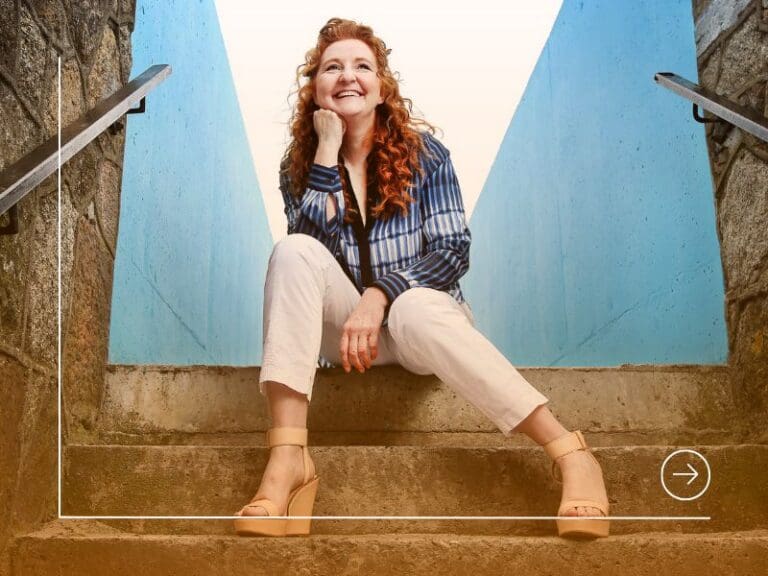
Dr. Niamh Shaw is a science communicator, explorer, and founder of Town Scientist.
Her background is in engineering and science, but her career has taken a very non-linear path – from completing a PhD, to becoming a professional actor, to now working at the intersection of science, storytelling, and exploration.
A core part of what Niamh does is translating highly technical environments into stories people can understand and connect with. She has worked on analogue astronaut missions, reported from space centres, and contributed to national media – including live broadcasts – helping bring complex scientific ideas into everyday conversations.
Alongside this, Niamh is working towards a personal goal that has stayed with her since childhood: to go to space, and to share that perspective with others.
How did you land your current role? Was it planned?
Not at all — in fact, it came from a moment of real uncertainty.
After finishing my PhD, I felt quite disillusioned. I knew I loved science, but I didn’t feel like I fit within the traditional academic path. What I had always been drawn to was communication — so I made a very unexpected decision and trained as an actor.
I worked professionally in theatre and television, including roles on Irish TV, and that experience completely changed how I understood storytelling and audience connection. Over time, I began collaborating with theatre-makers who were interested in my science background, and that’s where things started to merge.
What I do now is really the result of those two worlds coming together — science and performance — and building something new from that intersection.
What are the key roles in your field of work, and why did you choose your current expertise?
Science communication can take many forms — journalism, education, broadcasting, digital media.
My niche sits in translating complex, technical environments into human stories.
Whether I’m working with scientists on a Mars analogue mission or interviewing engineers at the European Space Agency, my role is to understand enough of the science to tell the story clearly — without losing its meaning.
I chose this path because I realised that access to science isn’t just about information — it’s about how that information is shared.
Did you (or do you) have a role model in tech or business in general?
I’ve always been inspired by astronauts — people who operate at the edge of what’s possible, but who can also communicate that experience back to Earth.
People like Chris Hadfield have shown how powerful it is when technical expertise and storytelling come together.
What are you most proud of in your career, so far?
Founding Town Scientist is something I’m incredibly proud of.
We work with families and communities who might not see science as something that belongs to them — and we’re seeing real shifts in confidence and engagement.
On a personal level, I’m also proud of the moments where I’ve had to step beyond my comfort zone and trust my ability to communicate under pressure.
Recently, I was asked to provide live commentary on a rocket launch for BBC News — and I couldn’t even see the launch itself. I had to interpret what was happening in real time and bring the audience with me.
Those experiences have shown me that many of the limits we feel are often self-imposed — and can be challenged.
What does an average work day look like for you?
There isn’t a typical day, but a lot of my work involves stepping into complex environments and figuring out how to make them accessible.
On analogue astronaut missions, like those at the Mars Desert Research Station, I worked alongside scientists running experiments, documenting their work using GoPros and audio in real time.
That meant quickly understanding unfamiliar scientific processes, capturing them accurately, and then later shaping that raw material into something an audience could follow.
At space centres, I’m often surrounded by highly technical language — engineering systems, planetary science, life support — and my job is to translate that into clear, engaging stories.
A lot of the real work happens afterwards in editing and storytelling.
Are there any specific skills or traits that you notice are important in your field?
The most important skill is the ability to translate.
You don’t need to be the deepest technical expert in the room — but you do need to understand enough to ask the right questions and communicate clearly.
My background in acting has been hugely valuable here. It taught me how to connect with an audience, how to stay calm under pressure, and how to communicate with clarity — even in live or high-stakes situations.
Adaptability is also key.
Have you ever faced insecurities and anxieties during your career, and how did you overcome them?
Yes — especially because my career hasn’t followed a traditional path.
I’ve had to work a lot on my own limiting self-beliefs. Even now, as someone working in space-related fields, there are moments where doubt creeps in.
But a big part of my journey has been learning how to move forward despite that fear. Confidence often follows action.
Entering the world of work can be daunting. Do you have any words of advice?
You don’t have to have everything figured out.
Careers are rarely linear. Follow what genuinely interests you — it often connects later.
What advice would you give other women wanting to reach their career goals in technology?
Don’t wait until you feel ready.
Confidence often comes after you take the step, not before.
And don’t underestimate the value of your perspective.
What drives you?
I’ve always had a fascination with space, and over time that’s become my North Star.
I’m working towards the goal of going to space, even now in what I would describe as my third career.
For me, exploration is about challenging fear and pushing beyond self-imposed limits. When you stop making decisions from a place of fear, it’s incredible what becomes possible.