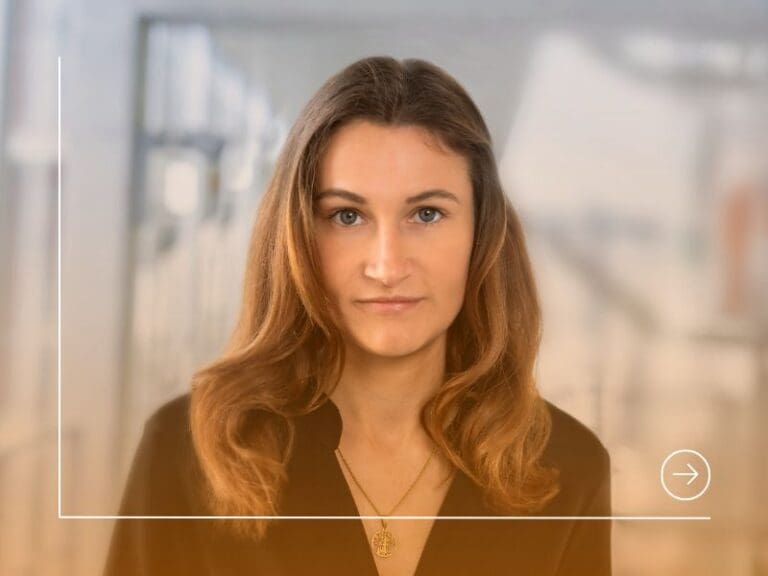

Eva Spatz is the VP, Head of People Experience at Staffbase, where she is helping to drive the company’s evolution into an AI-native Employee Experience Platform.
With a background in Business Psychology and over a decade of experience in training and development at Amazon Germany, Eva is passionate about demonstrating that Agentic AI and human-centricity are powerful partners. Eva is excited by the mission of shaping the future of work by fostering a culture of experimentation and “scrappy” courage within the People Experience space.
Did you (or do you) have a role model in tech or business in general?
My role model is certainly my mentor, Annelot Fluitman. She is not only an inspiring leader, but also always reminds me how being a woman in a leadership role can very much align with being a mother to young children, and how standing your ground for what is right can come with a high degree of flexibility to adjust and adapt. Annelot has been my manager for a short while in my career but she has left a very deep, positive impact on me. I think by truly having my back, supporting me and challenging me where it was helping with my growth, she was the person I inspire to be as a leader. When I then was given the opportunity to step up into a head of people role, she was one of the first people I called and asked her to become my mentor.
What are you most proud of in your career, so far?
There were many pivotal moments in my career, and overcoming challenges is probably the one thing that I am most proud of. With the AI transformation at Staffbase, I stepped into a role that
was new to me to find myself leading the people space at a time with huge uncertainty, a big strategic and technological change at hand and all of that with AI being front and centre of our transformation. A technology that is not only the most disruptive technology for decades but also a disruption that will impact how humans live and work. With limited answers to the big questions of a lifetime. So when it comes to connecting the ‘human centricity’ approach with AI-first philosophy, I believe that they now are inseparable to be answered. We have to think about AI when we design workplaces around humans and we have to deliberately add humans into any AI solution we build. It makes me incredibly proud to be allowed to play such a central role in shaping the future of human centric work in the age of AI at Staffbase.
Are there any specific skills or traits that you notice companies look for when you’re searching for roles in your field?
The most successful candidates are those who prioritise and value collaboration and possess the compatible traits that enable working as a team. You may be the smartest person in the
room but if you are hard to work with, you will find it harder to succeed as you are cutting off potential results that are gained with collaboration. There needs to be a shared empathy across the team, this requires skills that enable and encourage inquisition. People who succeed in this role are people who can balance a business mindset whilst retaining a care for employee wellbeing and truly wanting every individual to succeed. If they possess this characteristic, the business as a whole will thrive as it recognises talent and nurtures it accordingly. That same principle holds at the organisational level, too. If you design your workplace to reach and develop every individual, including those who are the hardest to reach, the whole business performs better.
Have you ever faced challenges during your career, and how did you overcome them?
Throughout my career, one of the most significant challenges I’ve faced is imposter syndrome. The transition hasn’t always been a straight line of confidence; there are moments when I
question if I truly belong. However, I’ve learned to reframe this discomfort as a sign of growth.
To overcome these moments, I’ve had to be honest about my knowledge gaps, proactively ask for help, and accept that I don’t need to have a map for everything. Crucially, I wouldn’t be where I am today without a strong support system of leaders and colleagues who recognized my potential and believed in me before I fully believed in myself.
Entering the world of tech can be daunting. Do you have any words of advice for anyone just starting out and feeling overwhelmed?
Entering tech can feel overwhelming, but it is important to remember that feelings of uncertainty are a clear sign you are in a “growth zone.” Rather than viewing these moments as a lack of capability, reframe them as opportunities for development. My primary advice is to actively seek out teams that prioritise psychological safety. These are environments where you feel encouraged to learn, experiment, and collaborate without fear of judgment. Finding a workplace that values support, mentorship, and open communication can transform that initial apprehension into an energising, positive experience. Remember that you do not need to have all the answers immediately; focus on surrounding yourself with colleagues who value your curiosity and potential as much as your current technical skill set. It’s also why I care so much about building psychological safety into the digital workplace itself because the same conditions that helped me grow are the ones every employee deserves, whether they’re sitting at a desk or working on a factory floor.
What advice would you give other women wanting to reach their career goals in technology?
I think women have all it takes to succeed but sometimes we need to acknowledge that we often are still ‘an exception’ in tech. Unfortunately, to this day, women both, in business and in society,
can be stronger and go further if they find support from other women. So if you are new to the tech industry, find a woman that has paved the way already and get her to have your back. And have hers. Let’s be allies for one another.