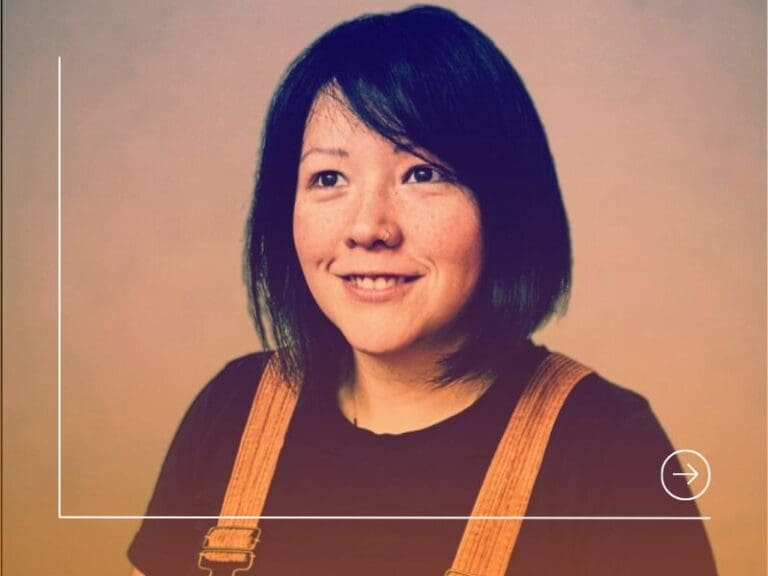

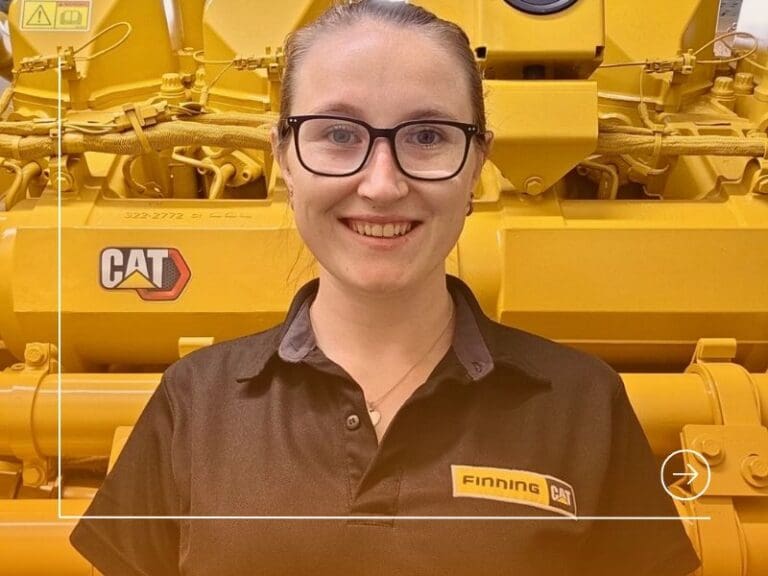
Katelyn Dunbar is a Field Engineer with Finning UK & Ireland, responsible for diagnosing, repairing and maintaining Caterpillar® engines and generators on site at customer locations.
Katelyn is a key member of the company’s data centre team, and the first woman in Ireland to complete a Finning service engineering apprenticeship. A typical day ranges from troubleshooting power and equipment issues to routine checks, diagnostics and repairs. Everything, down to completing the paperwork and following strict security procedures, is an essential part of the emergency backup power system that keeps the world online.
As part of the apprenticeship, which saw Katelyn qualify as a level three electromechanical technician, she studied a range of courses to help her understand the vital role of maintaining power system integrity. The multi-disciplinary training covered fuel systems, engine diagnostics and electrical fundamentals, among other applications.
How did you land your current role? Was it planned?
Design and technology were my chosen subjects at school and I started the apprenticeship with Finning straight after finishing my secondary education in 2020. It was a four-year apprenticeship and competition for a place on the programme was fierce. To be honest, I’d never heard of a power systems engineer until I joined Finning. But I knew I wanted to work in engineering and so decided I should just go for it.
The course was extremely comprehensive – we learned to rebuild engines, we gained electrical and cabling qualifications, we completed specialised fuel systems training. This was all while working out in the field soaking up hands-on experience and learning in ‘real world’ situations. After completing the apprenticeship in September 2024 I joined the data centre team, diagnosing electrical and mechanical issues and carrying out onsite repairs for clients.
What are the key roles in your field of work, and why did you choose your current expertise?
The type of work we do directly relates to critical business infrastructure – it is essential to the success of data security, energy efficiency, business continuity and optimised performance. The data centre team at Finning has to be the very best in its league to keep clients connected. Being based in Dublin, data centres are one of the cornerstones of the country’s economy. They support everything from emergency healthcare to online shopping. There is a great variety in the work we do – no day is the same.
Did you (or do you) have a role model in tech or business in general?
When I was aged nine, I was building engines on the kitchen table at home with my dad Paddy. My mum would go out shopping on a Saturday and we would spend hours taking apart and putting together a 1.2 litre engine from a ‘Boxy Starlet’, a Toyota Starlet that we raced at the hot rod club in Wexford. My dad is a plant fitter in the construction industry, and he would teach me about the different parts in the engine and the tools I needed. Before long I had my own little pink set of tools for Christmas! So yes my dad is my role model and has sparked this passion and curiosity in me for engineering.
What are you most proud of in your career, so far?
I enjoy all aspects of my work but during my apprenticeship we worked on a Caterpillar® 3618 – a high-performance, 4-stroke V18 marine diesel engine, primarily used for high-speed, large commercial vessels and offshore applications. We had to dismantle and rebuild it in cramped conditions, working together to lift the parts up to deck on a ferry. The Cat 3618 is roughly about 12 feet high and 20 feet long so it was an amazing piece of equipment to work with and an incredible experience. Today, when our current apprentices carry out this training, I’m invited down there as one of the engineers supporting their learning. I’m incredibly proud of that.
What does an average work day look like for you?
Your typical data centre generator engine is anywhere between a 12 cylinder and a 20 cylinder engine. The goal is to take such good care of them that we are not in a situation where we need to carry out any rebuilds or massive repair work with them. So most days I am involved in typical preventive maintenance. If the generators go down, our clients can potentially lose millions every minute so scheduled inspections and servicing is crucial.
We can never predict when we might get a call-out if there are any issues, and that call can come any time of the day or night. In the main we carry out routine tests and checks to ensure reliability, maximise the lifespan of the equipment and prevent failure. And then in addition to the work out on site we have to ensure compliance in the records we keep and systems we use, keeping documentation up to date to track performance.
Are there any specific skills or traits that you notice companies look for when you’re searching for roles in your field?
Obviously there is a wide range of technical skills needed but it goes further than that – I think employers are looking for people who have a passion for problem solving and understanding systems to improve product performance. It is also about understanding the customer and how the work we carry out has an impact on their productivity and ultimately profitability. We have to see ourselves as an extension of their teams, working together for the most efficient results. Being forward thinking is also essential, being prepared to embrace the latest innovations and technology.
Has anyone ever tried to stop you from learning and developing in your professional life, or have you found the tech sector supportive?
In a world where data generation is continually picking up speed, continuous learning and professional development is essential so we are always involved in practical training and increasing our awareness of different types of equipment. Emerging technologies are so important in our industry and Finning offers a range of CPD opportunities. I wouldn’t be able to do my job to the expected standard without it. It’s a very supportive industry.
Have you ever faced insecurities and anxieties during your career, and how did you overcome them?
I am the first woman in Ireland to complete the Finning apprenticeship and my own experience has been very positive. While it might have felt a bit daunting and intimidating to go into the workplace at first, what new job doesn’t feel like that? I believe if we have more women talking about their roles and achievements and acting as STEM advocates, children as young as primary school age will get used to thinking about how they can use their talents to make a difference.
Entering the world of work can be daunting. Do you have any words of advice for anyone feeling overwhelmed?
Each month at Finning we hold a Teams event for women working across the company when we discuss our challenges, our experiences, and extend a little bit of support to each other. I’d say don’t be afraid to talk about the challenges you are experiencing, as the chances are other people have been in the same situation and just talking to them can really help. The more we expose barriers to progression the more likely it is we can stamp them out.
What advice would you give other women wanting to reach their career goals in technology?
I think if you believe in something then don’t be afraid to show that passion and that belief in the work that you do. Be confident in yourself and go for it. I care deeply about encouraging young people, particularly girls, to consider engineering as a career before they get to secondary school. I don’t think girls are necessarily afraid of going for jobs in male-dominated industries. I think it is more the case that by the time we get to secondary school age, minds are already made up about the type of career someone wants to pursue.
We should be trying to plant those seeds before pupils move on to college or secondary school where science might start to seem less attractive as a career option. I was really lucky to grow up surrounded by people who supported my goals and that has stayed with me. Women in technology can support each other and inspire the next generation to do the same.