
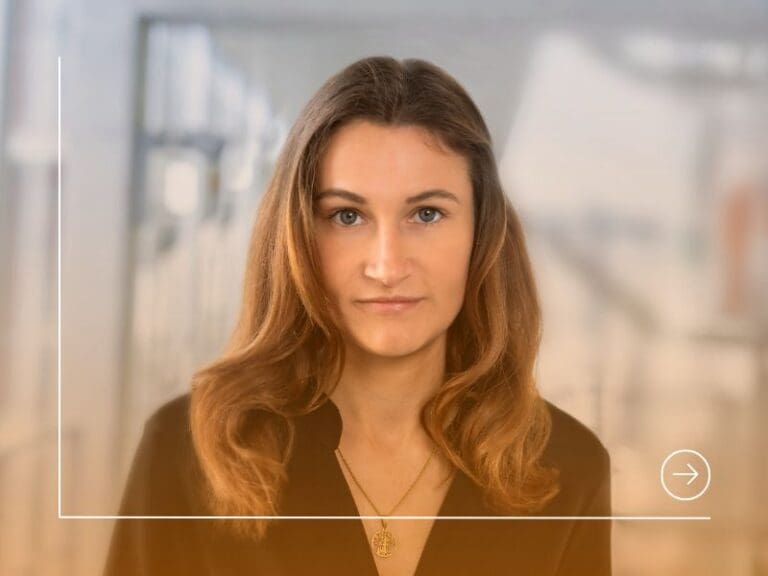
Jil Birgel is a Senior Associate at Alvarez & Marsal Digital Transformation Services, based in Hamburg.
With more than five years of experience as a management consultant, Jil has established herself as a dedicated financial services professional, excelling in IT transformation and operational excellence within the financial sector. She has extensive experience in digital strategy, IT project management, core banking / software migration and business process management. She has worked with various clients across software industry and the financial services industry, with a particular focus on the banking sector.
How did you land your current role? Was it planned?
No, not at all. I didn’t set out with a carefully mapped career in technology.
During an internship at a smaller consultancy, I was assigned to a core banking migration in Luxembourg and expected to work it out. So I did.
My academic background was in finance rather than computer science, so it was quite a baptism of fire. The project wasn’t exactly designed to charm newcomers: z/series Mainframe, a 3270 terminal, green text on a black screen and core systems that had been running quietly for years…
But what I quickly fascinated me was that the technology landscape of a financial institution is effectively its business history expressed in architecture. Products, acquisitions, regulatory requirements and decades of good and less good decisions all leave their mark. Add enormous transaction volumes, and the technology is not merely supporting the business—it is the business. That experience shaped my career, and today I advise Financial Services clients and other large corporates on technology restructuring, with a focus on platforms, operating models, sourcing and technology performance.
What are the key roles in your field of work, and why did you choose your current expertise?
I work in technology restructuring for Financial Services institutions and large corporates, focusing on legacy platforms, technology operating models, sourcing and the performance of complex technology estates.
That work brings together enterprise architects, engineers, infrastructure specialists, finance and procurement teams, commercial experts and senior business leaders. My role is to connect those different perspectives and turn them into decisions that work technically, operationally and financially.
That might mean helping a client decide the future of a platform, restructuring a technology organisation, determining which capabilities should remain in-house, or evaluating whether an existing sourcing model still delivers the value it promises.
I was drawn to the field because the issues refuse to stay neatly within one discipline. Architecture, cost, organisational capability and business strategy all have an inconvenient habit of being connected, and finding solutions means understanding how they influence one another.
Did you or do you have a role model in tech or business?
Stephanie Shirley feels particularly close to home. She was born in West Germany (North Rhine-Westphalia), similar to my own family background. It is a region with a very strong industrial identity—coal, steel and heavy engineering—and where women were historically more likely to be associated with keeping that world running than with founding software companies.
Perhaps that is why her story resonates slightly with me. She built a highly successful technology business in Britain and famously signed her letters as “Steve” because “Stephanie” was less likely to receive a reply.
What I admire most is her combination of pragmatism and ambition. Rather than accepting the barriers in front of her, that she not only found a clever way through the door but also built a commercially successful company and created serious careers for highly skilled women long before diversity was a corporate priority.
What are you most proud of in your career so far?
The things that I’m proudest of are rarely individual achievements.
Over the past few months, my teams have delivered some significant results in a very tightly run restructuring engagement. The time pressure was intense, the stakes were high and there was limited room for elegant theory. We had make difficult decisions with imperfect information and keep moving.
Seeing the team deliver under that level of pressure was impressive and rewarding.
In restructuring, success is usually tangible: either the decisions hold up and the organisation moves forward, or they do not. In this case, they did.
What does an average workday look like for you?
No two days are ever the same! It’s the level of intensity that’s rather more consistent.
One hour might be spent on platform architecture, the next on sourcing, cost or execution. The common denominator is tight deadlines, significant personal responsibility and direct exposure to senior management.
That means being prepared, forming a view quickly and staying close enough to the detail to defend it. Senior stakeholders are generally very good at noticing whether an answer is based on substance—or has simply been presented with confidence.
Are there any specific skills or traits that companies look for when recruiting into your field?
The strongest people in this field tend to combine technical curiosity with commercial judgement.
They want to understand how a system actually works, but also recognise that the technically perfect answer is not necessarily the most practical or economically sensible one.
Structured thinking matters because large technology estates are inherently complex. Communication is equally important. Being able to explain the same decision to an engineer, an executive and an investor—without changing the substance or losing any of your rationale—is crucial.
Has anyone ever tried to stop you from learning and developing professionally, or have you found the sector supportive?
Overall, I’ve found the sector to be supportive, although I wouldn’t say credibility is always granted on arrival.
In many rooms, particularly when I’m younger than most people present or one of very few women, I’vefirst had to earn my place in the discussion.
What helped was being the person with substance: knowing the detail, asking the question others may have missed and making a point that holds up under scrutiny.
I’ve learned that, once the room realises you understand the issue, the dynamic usually changes. Content has a rather efficient way of settling the matter.
I’ve found that the people I’ve learned most from were generous with their expertise, but still expected me to form and defend my own view. That has probably been the most valuable kind of support I’ve encountered.
Have you ever faced insecurities or anxieties during your career, and how did you overcome them?
Of course. Early on, it can be intimidating to discuss a platform with people who have worked on it for longer than you have been in the workforce.
What helped was becoming comfortable to ask the apparently obvious question. Quite often, that question reveals something that no one in the room is confident about.
That is usually the useful turning point – once nobody has to maintain the fiction of knowing everything, the politics tend to recede and focus can shift to solving the problem.
I’ve learned that confidence comes less from having every answer and more from being comfortable enough to surface what nobody quite knew yet. “I don’t know yet” is an entirely credible answer, provided it is followed by a sensible plan to find out.
Entering the world of work can be daunting. What advice would you give someone feeling overwhelmed?
I would treat the first role as a starting point, rather than a verdict on the rest of your career.
Career paths tend to become coherent only in retrospect. The project that redirected mine arrived without a strategic plan, an ideal title or a particularly polished narrative.
A strong learning environment, thoughtful colleagues and difficult problems are often more valuable than a role that appears perfectly designed on paper. Technically demanding work can look intimidating from the outside, but once you start breaking it down, it usually becomes manageable—and occasionally rather enjoyable.
What advice would you give other women who want to achieve their career goals?
Confidence is often something you practise before you fully feel it.
Particularly in consulting, presence matters. Know your subject, prepare thoroughly and then allow yourself to take up some space. You don’t need to apologise for not knowing everything; nobody enters a meeting carrying the entire internet in their head.
More experienced colleagues don’t have all the secrets, either. Quite often, they are simply more comfortable thinking aloud—and occasionally saying something with sufficient conviction that it survives the meeting.
The aim isn’t to bluff. It’s to know your material well enough to distinguish between what you know, what you can work out and what genuinely needs further analysis.
Preparation gives you the freedom to be spontaneous. So stand a little taller, make your point clearly and do not take either yourself—or the occasional imperfect answer—too seriously.